Are We Witnessing the End of Easy Grant Funding? Is the Traditional Grant Model Still Fit for Purpose?
By Patience Khasoa
For decades, grant funding has been one of the primary lifelines for nonprofit organisations, community-based organisations, research institutions, and social enterprises. A well-written proposal, aligned with a donor’s priorities, often opened doors to funding opportunities. However, the grant landscape in 2026 tells a different story.
Today, organisations are discovering that writing an excellent proposal is no longer enough. Funders are asking a more important question: Can you prove that your work creates measurable, lasting change?
The New Reality of Grant Funding
The global development landscape has changed significantly. Economic uncertainty, geopolitical conflicts, climate emergencies, humanitarian crises, and shifting donor priorities have placed immense pressure on available funding. At the same time, the number of organisations competing for grants continues to increase.
This means that grant funding has become more competitive than ever before. Organisations that once relied on traditional proposal writing are finding that success now depends on much more than persuasive narratives.
From Activities to Impact
One of the most significant shifts is the growing emphasis on measurable impact.
Funders are increasingly interested in outcomes rather than activities. Instead of asking, “What will you do?” they are asking:
- What measurable change will your project create?
- How will you collect and verify evidence?
- Can the impact continue after the grant ends?
- What lessons have you learned from previous projects?
Organisations that invest in strong Monitoring, Evaluation, Accountability, and Learning (MEAL) systems are better positioned to answer these questions and demonstrate value for money.
Diversifying Income Is No Longer Optional
Another emerging trend is the expectation that organisations become financially resilient.
Many funders are cautious about supporting organisations that depend entirely on grants. They want to see sustainability plans that include diverse revenue streams, such as:
- Social enterprises
- Membership contributions
- Corporate partnerships
- Individual giving campaigns
- Fee-for-service consulting
- Local fundraising initiatives
Financial diversification signals that an organisation can continue delivering impact even when grant cycles end.
Trust Is Becoming a Competitive Advantage
In today’s funding environment, trust matters as much as technical expertise.
Funders increasingly assess an organisation’s governance, financial accountability, transparency, safeguarding policies, and ethical leadership before making funding decisions.
Organisations that communicate openly, report honestly on successes and challenges, and maintain strong relationships with communities are more likely to earn long-term donor confidence.
Trust is no longer an intangible value – it is a strategic asset.
Innovation and Collaboration Matter
Grant makers are also seeking organisations that embrace innovation.
This does not necessarily mean adopting expensive technologies. Innovation can include community-led solutions, digital monitoring systems, climate-smart interventions, or new partnership models.
Collaboration is equally important. Increasingly, donors prefer funding consortiums and partnerships rather than isolated organisations.
Working together allows institutions to combine expertise, reduce duplication, and maximise impact.
The Role of Artificial Intelligence
Artificial intelligence has transformed grant writing by helping organisations draft proposals, analyse funding opportunities, and improve efficiency.
However, AI cannot replace genuine community engagement, strategic thinking, or evidence-based program design.
Funders can distinguish between proposals that merely sound impressive and those grounded in real needs, credible data, and authentic partnerships. Technology should enhance – not replace – the human insight behind successful grant applications.
Is the Traditional Grant Model Still Fit for Purpose?
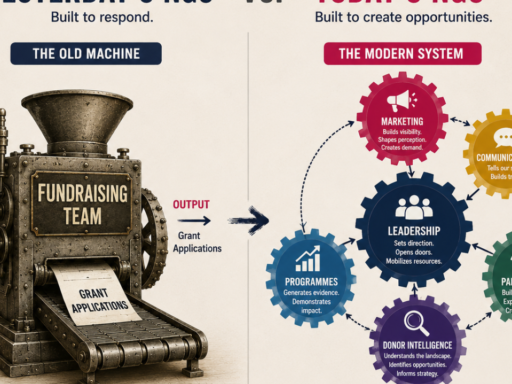
The traditional grant model is not disappearing, but it is evolving. The organisations most likely to succeed are those that move beyond viewing grants as isolated funding opportunities. Instead, they see grants as part of a broader strategy for creating sustainable social impact.
Winning grants in 2026 requires organisations to demonstrate measurable results, diversify their funding sources, strengthen governance, embrace innovation, and cultivate lasting relationships with both donors and communities.
Looking Ahead
The era of “easy grant funding” is fading. Yet this shift also presents an opportunity.
Organisations that prioritise accountability, learning, transparency, and long-term sustainability will be better equipped not only to secure funding but also to create meaningful and lasting change.
Perhaps the question is no longer “How can we write a winning proposal?”
Instead, we should ask:
“How can we build organisations that funders – and communities – can trust for years to come?”
(Patience Khasoa is a Kenyan fundraising specialist and resource mobiliser, and Grants Programme Manager at Grants Research Advisory Capacity Enhancement)