Your Fundraising Team Was Built for Yesterday’s NGO
By Lucy Njue
There is a thought that has been quietly forming in my mind over the past few months.
It began as an observation. Then it became a question. Now, I think it deserves a conversation.
I have started wondering whether many nonprofit organisations are expecting today’s fundraising teams to solve yesterday’s fundraising problems.
The Team Made Sense. Then the World Changed.
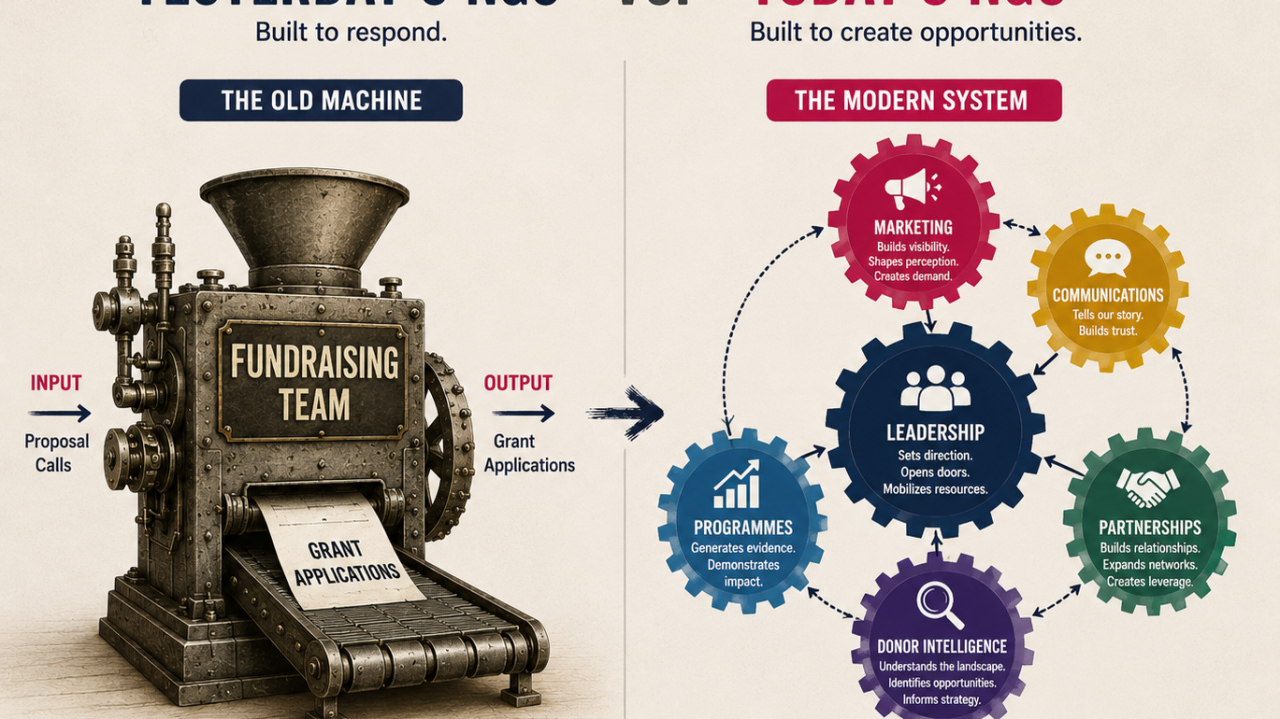
For years, fundraising in many NGOs has been structured around one dominant activity: responding to calls for proposals.
When a funding opportunity appears, the fundraising team springs into action. Programme colleagues provide the technical content. Budgets are prepared. The proposal is written. The application is submitted.
For a long time, this made perfect sense.
Institutional donors were the primary source of funding for many organisations. Success depended largely on identifying opportunities and writing strong proposals. So organisations built fundraising teams accordingly.
But the fundraising landscape has changed. Today, organisations are expected to do much more than write proposals.
They need to build relationships long before funding opportunities emerge. They need to communicate their impact consistently. They need to strengthen their reputation, engage different types of donors, explore local philanthropy, cultivate corporate partnerships, and position themselves as organisations that donors already know and trust.
Those activities require a very different set of capabilities.
Yet many organisations are still relying on fundraising structures designed for a different era.
We Keep Asking Proposal Writers to Be Marketers
That is why I believe many fundraising teams are not underperforming because they lack talented people. They are underperforming because they have been asked to do work their teams were never designed to do.
People with strong programme backgrounds staff many business development teams. They understand donor priorities. They write excellent proposals. They can translate technical ideas into compelling narratives.
These are valuable skills. But proposal writing is only one part of modern fundraising.
Today’s fundraising requires people who know how to position an organisation in the market, build visibility before funding opportunities arise, understand donor behaviour, create demand for the organisation’s work, and nurture relationships long before an ask is made.
These are marketing capabilities. Marketing is not simply about designing brochures or managing social media.
At its best, marketing answers critical fundraising questions. Who knows we exist? What are we known for? Why should someone trust us before we ask them for funding?
Organisations that answer these questions well do not start building their reputation when a funding opportunity is announced.
They have been building it for months, sometimes years.
Fundraising Is Bigger Than the Fundraising Team
This is why I increasingly think fundraising should not be viewed as the responsibility of one department. It is an organisational function. Programme teams generate evidence and demonstrate impact. Marketing and communications shape how the organisation is understood, remembered, and trusted. Leadership opens strategic relationships and champions resource mobilisation.
Fundraising brings these pieces together into a coherent strategy that creates opportunities before the next call for proposals is announced.
When these functions work in isolation, fundraising becomes reactive.
When they work together, fundraising becomes intentional.
Perhaps It Is Time to Redesign the Function
Perhaps the conversation nonprofit leaders need to have is not whether their fundraisers need another proposal writing workshop. Perhaps the better conversation is whether the fundraising function itself reflects today’s funding environment.
Because sustainable fundraising is rarely the result of one exceptional fundraiser. It is the result of a system where different capabilities work together toward the same goal.
Perhaps the question is no longer:
Do we have good fundraisers?
Perhaps the better question is:
Have we built a fundraising function that reflects the world we are fundraising in today?
I think the biggest fundraising challenge facing many organisations today is not finding the next donor. It is redesigning the team expected to find them.
(Lucy Njue is a Kenyan fundraising and sustainability strategist, and Founder and Executive Director of Realtime Insights)