

The Most Strategic Thing You Can Do Is Say No
Dr Lucille Abruquah
Why accepting the wrong grant is one of the most expensive decisions a nonprofit can make, and a practical decision tree for knowing when to walk away.
The grant you say yes to will cost you more than the grant you say no to.
That sounds wrong, I know. It feels wrong, especially if you are running an organisation where every dollar matters and every funding gap keeps you up at night.
But here is what I have learned and what the best-funded organisations in Africa’s civil society sector consistently demonstrate: the ability to say no to misaligned funding is not a luxury reserved for well-resourced organisations. It is a discipline that creates well-resourced organisations.
Hear me out. The grant you said yes to when you shouldn’t have doesn’t just cost you time and energy; it costs you mission clarity, staff wellbeing, donor credibility, and sometimes the very identity of the organisation you set out to build.
The Story That Started This Conversation
In a previous article, I shared a story about a time we said no to a donor.
We had applied and passed multiple stages of due diligence, including partner checks with community representatives, other donors, and implementing organisations. We were ready. But when the terms arrived, something was wrong. The funding amount was insufficient. The conditions would have compromised our independence, and accepting them would have meant delivering work that didn’t align with where we were trying to go.
So we said no. It was one of the hardest decisions I have been part of.
Weeks later, the donor came back on our terms. When I asked why, the answer was simple: “We trust that your organisation has the systems and partnerships to deliver beyond attribution. You have a comprehensive strategy that shows where you’re going, how we fit in and every partner we spoke to vouched for your work.”
That no became a yes…a better yes, with better terms and alignment. This happened because we had a strategic plan clear enough to know the difference between a good opportunity and a right one.
Let me give you a lighter way to think about this before we get into the numbers.
Accepting a grant from the wrong donor is a lot like saying yes to a marriage proposal from the wrong person. The proposal might be flattering, the timing might feel right, the financial security might seem appealing, but if the values don’t align, the terms feel uncomfortable, and you’re quietly hoping they’ll change, you already know the answer.
The problem is that saying no feels harder than saying yes. So you say yes and then you spend the next three years delivering on a commitment that was wrong from the beginning.
The cost of that yes, in this analogy and in fundraising, is almost always higher than the discomfort of the no. Now let’s follow the money on what a wrong yes actually costs.
The Full Cost of a Wrong Yes
Most nonprofit leaders think of a wrong yes as a missed opportunity and time spent on work that wasn’t quite right, but the real cost is significantly higher.
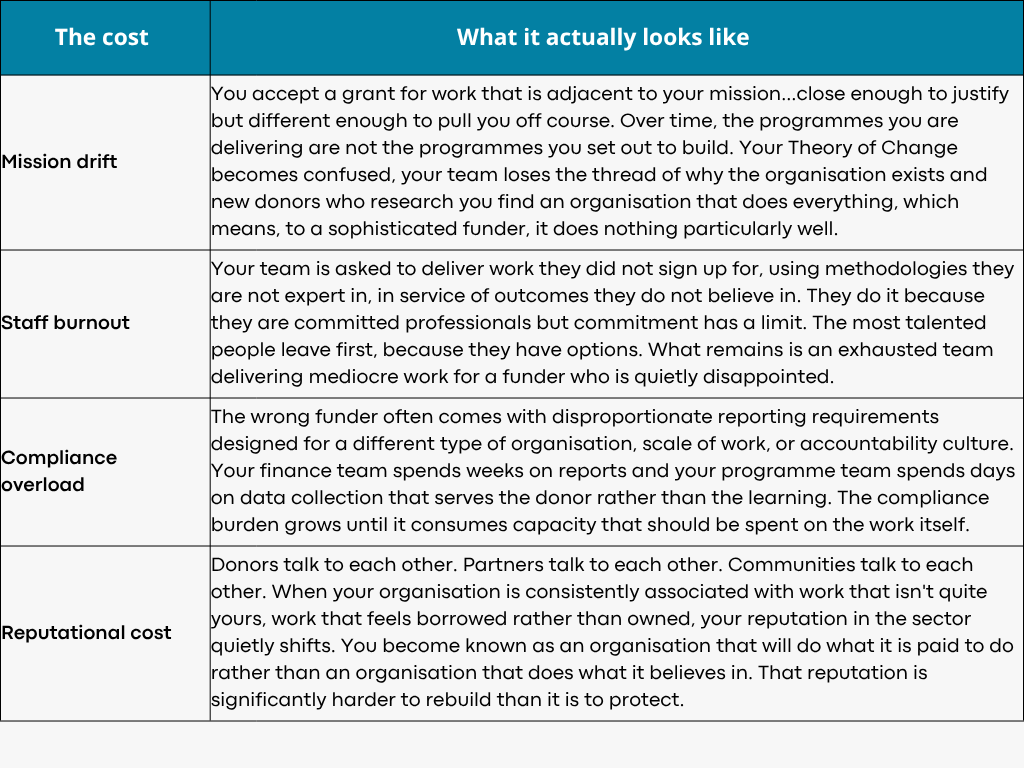
The compounding problem:
These four costs don’t arrive separately; they arrive together and reinforce each other. Mission drift creates staff burnout, staff burnout produces compliance failures, and compliance failures damage donor relationships. Furthermore, damaged donor relationships force the organisation to accept more misaligned funding to stay afloat. The wrong yes is often the beginning of a cycle that is very difficult to exit.
What Makes a Yes Wrong, The Five Warning Signs
Not every uncomfortable grant is a wrong yes. Stretching to deliver something ambitious, accepting terms that require discipline and rigour, working with a demanding funder who holds you to a high standard? These are NOT warning signs; they are the conditions under which organisations grow.
Here are the five warning signs that a yes is wrong:
1. You are rewriting your mission to fit the application: If you are adjusting what your organisation fundamentally is, not just how you describe it, to match a donor’s priorities, that is not strategic communication; it is mission drift in progress.
2. The funding amount doesn’t cover the real cost of delivery: Accepting underfunded grants forces organisations to subsidise donor projects with their own unrestricted resources, which drains the organisation and creates hidden financial pressure that never appears in the reporting.
3. The reporting requirements are disproportionate to the grant size: A $20,000 grant with quarterly reports, monthly financial statements and bi-annual site visits is not a grant. It is a compliance burden that will cost more in staff time than the grant is worth.
4. The funder wants attribution over impact: Some funders want their logo on everything, their narrative in every report and their theory of change driving every decision. That is their right, but it is incompatible with organisations that have built their own credibility on their own evidence base.
5. Your best people are quietly uncomfortable: Before any funding decision, pay attention to the energy in the room when the opportunity is discussed. Quiet discomfort, qualified enthusiasm and questions that reveal doubt are often more accurate signals than the financial analysis.
How to Say No Without Burning the Bridge
Saying no to a donor is uncomfortable, but how you say no determines whether you close a door or defer a conversation.
The organisations that do this well follow three principles:
Say no early: The earlier in the process you decline, the less goodwill you spend. Declining at the expression-of-interest stage is far less damaging than withdrawing after a full application. If you know early that the alignment is wrong, act on that knowledge early.
Be specific and honest: “This opportunity doesn’t align with our current strategic direction” is more credible and more respectful than a vague excuse. Funders respect organisations that know where they are going well enough to recognise misalignment clearly.
Leave the door open: “We don’t think this is the right fit at this stage, but we would welcome a conversation about future opportunities as our work develops” is not just courteous; it is strategically intelligent. The donor who hears no today, handled with respect and clarity, may become the funder who calls you first when the right opportunity opens.
A sample decline message:
“Thank you for this opportunity and for your confidence in our work. After careful consideration, we have concluded that this particular call is not aligned with our current strategic direction. We believe that accepting funding where alignment is limited would not serve either your investment or our mission well. We respect your work and would welcome the opportunity to stay connected as we develop. We hope there will be a better-aligned opportunity to work together in the future.”
The Go / No-Go Decision Tree
Think of this decision tree as your pre-proposal checklist, the equivalent of the honest conversation you should have before saying yes to a serious relationship.
In dating, you don’t just ask “are they attractive?” You ask whether your values align, the timing is right, and you can see a future together.
The same rigour applies here. Before submitting any application, work through these seven questions. It takes ten minutes. It will save you months of misaligned delivery and potentially years of quiet organisational suffering.
If you get a STOP at any question, that is your gut telling you what your spreadsheet is too polite to say. Listen to it.
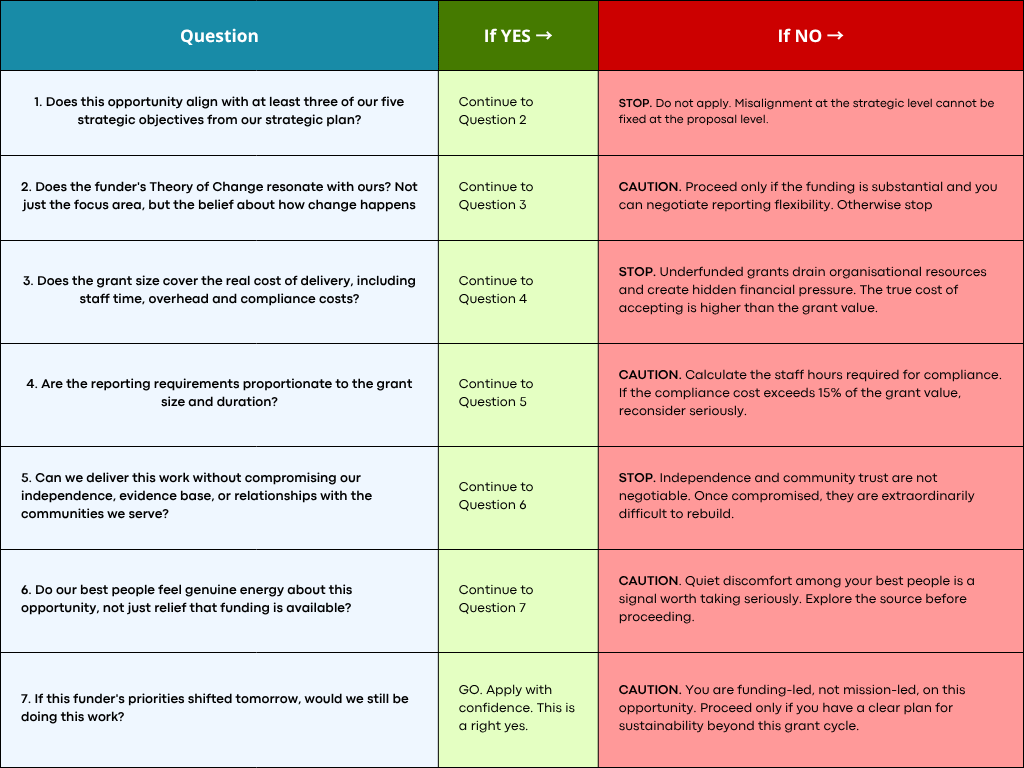
How to use this tree:
A STOP at any question means do not proceed without fundamentally reconsidering the opportunity. A CAUTION means proceed with eyes open and a mitigation plan. A GO at Question 7 means the alignment is genuine and the application is worth your full investment. Review this tree as a team, not just as a leadership decision. The people who will deliver the work should have a voice in the go/no-go decision.
Final Thought
The donor who came back in Issue 4 came back because they trusted us, and they trusted us because we had demonstrated, through that single difficult no, that we knew who we were and where we were going.
That trust was not built by being flexible. It was built by being clear.
Strategic coherence, the clarity that comes from a strong strategic plan, a robust Theory of Change and a proactive fundraising strategy is what makes the no possible. Without it, every opportunity feels like one you cannot afford to miss. With it, you can see clearly which opportunities are worth your best work and which ones would quietly cost you everything.
Say yes deliberately. Say no strategically, and when you say no, say it well.
(Dr Lucille Abruquah is a Ghanaian sustainable development expert, Adjunct Lecturer and Director of Grants Development at Nobel International Business University, and Grants Specialist at the Ghana International School. Subscribe to her The Systems Edge newsletter for more thought leadership insights on funding and fundraising issues)