


Stop Chasing Grants and Start Attracting Them – The Shift to Proactive Fundraising
By Dr Lucille Abruquah
Picture a Monday morning in a typical African nonprofit office. The Programme Manager forwards an email to the Executive Director. A foundation has just opened a call for proposals. Deadline: four weeks. Focus area: youth economic empowerment. Funding range: $50,000 to $150,000.
The Executive Director reads it twice. The organisation doesn’t work specifically on youth economic empowerment, but there’s overlap. They work on community resilience. That’s close enough, right?
A team meeting is called, and a team is assigned to write the proposal. The next four weeks are consumed by adapting the programme design, reframing the narrative, pulling together supporting documents, and chasing partners for letters of support.
The proposal goes in on the last day. Fingers are crossed. Six weeks later, a rejection email arrives. “We received a high volume of applications and regret to inform you…”
After everyone sits with the sad news for a few minutes, the cycle begins again. Another call, another adaptation and another four weeks… yet again, an unsurprising rejection.
If this scenario feels familiar, it is. It describes how most African nonprofits fundraise. Their leaders may be talented, and their work may be valuable, but unfortunately, they have never been shown a different way.
The Problem With Reactive Fundraising
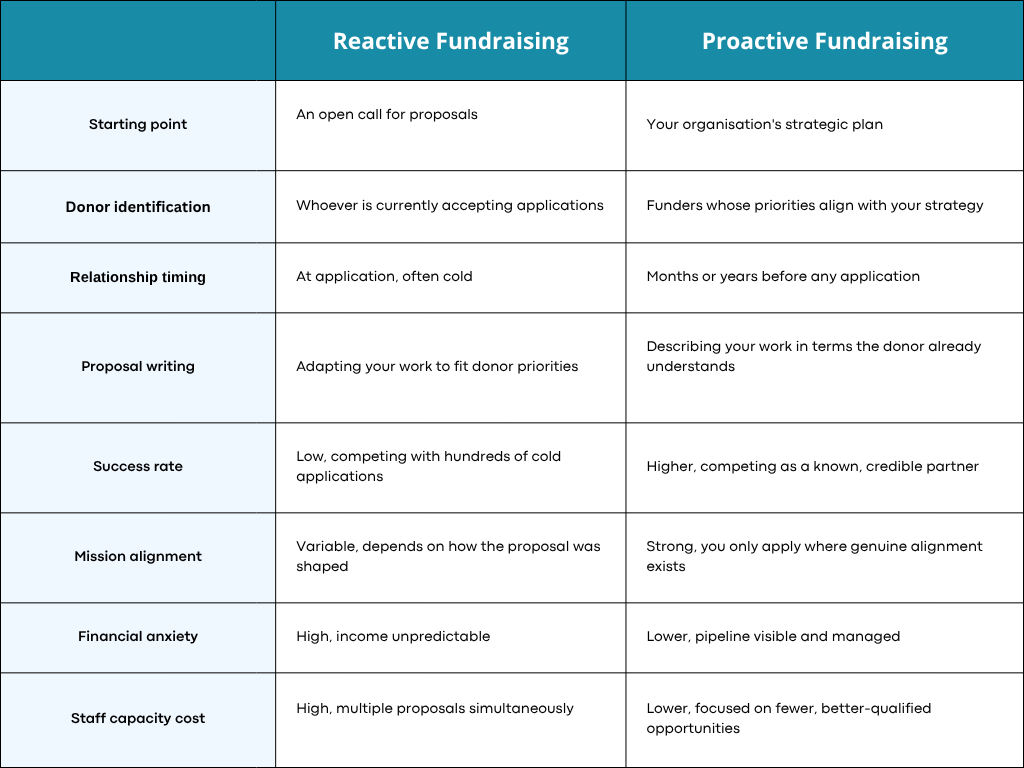
Reactive fundraising, which is basically applying for grants as they become available, adapting your work to fit donor priorities, and treating every open call as a potential opportunity, is exhausting, inefficient and ultimately self-defeating.
Here is what reactive fundraising actually costs:
It costs you time: Writing proposals costs staff hours. When those proposals are written reactively, adapted from your actual work to fit a donor’s framework, the time investment is even higher because you are essentially redesigning your programme on paper every time.
It costs you alignment: When you repeatedly reshape your work to fit donor priorities, mission drift becomes almost inevitable. Over time, the organisation you are delivering is not the organisation you set out to build.
It costs you relationships: Reactive fundraising is transactional. You approach donors when you need something, at application time. Proactive fundraising is relational. You engage donors well before any application opens, which means by the time a call comes out, the relationship already exists.
It costs you confidence: Organisations that fundraise reactively are always slightly anxious about where the next grant is coming from, whether the current proposal will succeed, or whether the pipeline is full enough. That anxiety is corrosive, which affects decision-making, staff morale and strategic clarity.
What Proactive Fundraising Looks Like
Proactive fundraising starts with a strategic plan, not with an open call.
It defines where you are going, what it will cost to get there and what kinds of funders are likely to support that journey. The fundraising strategy flows from the strategic plan, not the other way around.
Proactive fundraising organisations do something most reactive organisations never do: they research their donors before any call opens. They identify aligned funders, study their priorities and cycles, build relationships over time and position themselves as credible partners long before an application window appears.
When a call eventually opens from a funder they have been cultivating, the proposal almost writes itself. The relationship exists, alignment is established, and credibility is already built.
Reactive vs Proactive Fundraising: A Direct Comparison
How to Make the Shift: Four Practical Steps
Let me paint a clearer picture of what proactive fundraising actually looks like before we get into the steps.
Honestly, fundraising is a lot like dating. You don’t walk up to someone you have never met and say, “Hi, nice to meet you. Will you marry me? And by the way, I need $100,000 to take care of our unborn children”. Sir, we haven’t even had coffee yet!
That would be…ambitious!
Courting a donor works much the same way. You get to know them first, show up where they are, listen to what matters to them, understand what they care about and where your interests genuinely overlap. You also let them get to know you too…what you do, what you believe in, your achievements and what you are trying to change.
Gradually, genuinely, over time. Then, when the right opportunity comes along, the big ask doesn’t feel like a proposal from a stranger. It feels like the natural next step in a relationship you’ve been building.
That’s what I mean by proactive fundraising. It’s not about desperately chasing every funding opportunity that lands in your inbox, but rather building the right relationships before you need the money.
Now, let’s get into what that actually looks like.
Step 1 – Map your current funding landscape: Before you can be proactive, you need to understand where you currently are. List every active donor relationship, grant in progress and renewal coming up in the next 18 months. This is your baseline. It tells you where your income is concentrated, where the gaps are, and how much financial runway you have to invest in proactive relationship building.
Step 2 – Identify your target funders: Using your strategic plan as your guide, identify 10 to 15 funders whose stated priorities, geographies and funding sizes align with your strategic objectives. Focus on the ones whose Theory of Change resonates with yours, not every foundation that funds nonprofits. Research their grant cycles, application processes, typical grant sizes and recent grantees. This research takes time; it is also the most valuable fundraising investment you can make.
Step 3 – Build a relationship before you need one: Most funders attend sector events, publish reports, share thinking on social media and welcome introductory conversations with organisations doing relevant work. Engage with them there, not with a proposal, but with genuine interest in their thinking. Share your evidence, reference their work and attend their convening. When the call opens, you are not a cold applicant; you are a familiar name with a track record of engagement.
Step 4 – Manage your pipeline deliberately: A proactive fundraiser treats their donor pipeline the way a sales professional treats a CRM… with a clear view of who is at what stage of the relationship, what the next action is and when the next touchpoint should happen. A simple spreadsheet is sufficient; the discipline is what matters.
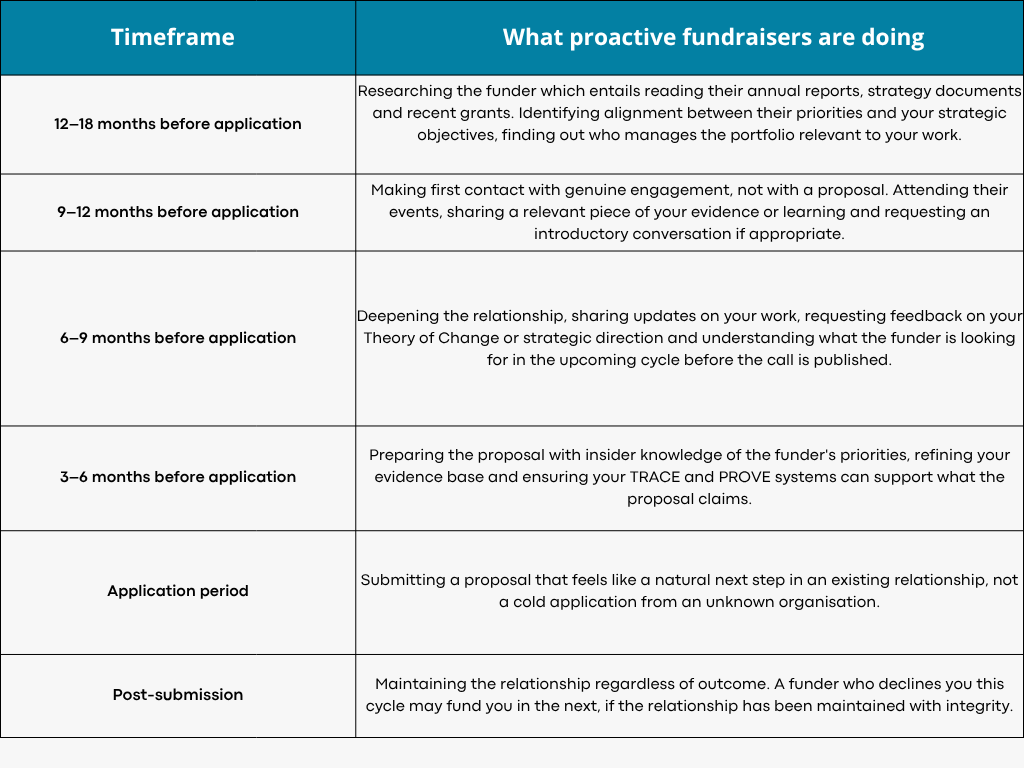
The Donor Relationship Timeline: When to Do What
One of the most practical tools a proactive fundraiser can have is knowing when to do what. relative to a donor’s typical funding cycle. Most major foundations operate on annual or biennial grant cycles. Understanding those cycles allows you to plan your engagement deliberately.
Here is a general donor relationship timeline that applies to most foundation funders:
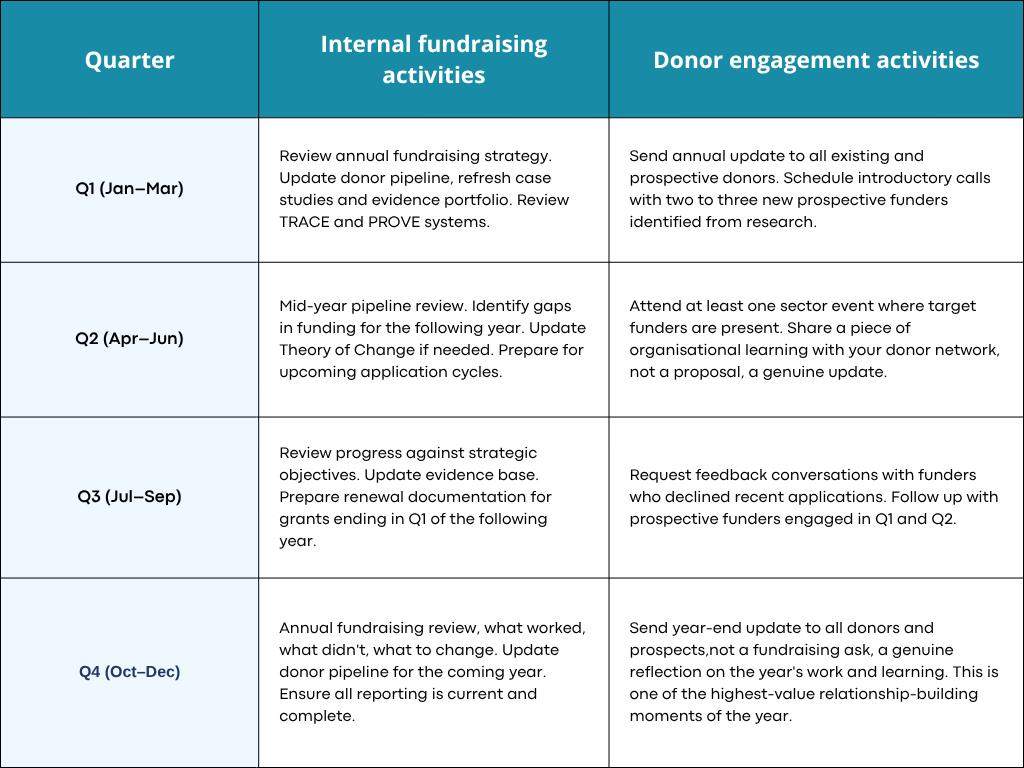
The Proactive Fundraising Calendar: A Quarterly Framework
A proactive fundraising calendar is not a list of deadlines; it is a year-round system of activities that keeps your pipeline moving, even when no calls are currently open.
Here is a quarterly framework that any organisation can adapt:
Final Thought
Reactive fundraising keeps organisations alive; proactive fundraising allows them to thrive.
The shift is not easy, especially for organisations that have been in survival mode for years, lurching from one grant cycle to the next. The organisations that make it are the ones that decide, at some point, that the cycle has to change.
That decision usually starts with a strategic plan, which is why Issue 24 came before this one. Without a clear sense of where you are going and who funds organisations like yours, proactive fundraising has no anchor. With it, everything in this issue becomes significantly easier to implement.
(Dr Lucille Abruquah is a Ghanaian sustainable development expert, Adjunct Lecturer and Director of Grants Development at Nobel International Business University, and Grants Specialist at the Ghana International School. Subscribe to her The Systems Edge newsletter for more thought leadership insights on funding and fundraising issues)