

The Best Grant Proposals are Built Before They are Written
By Alfred Akerele
One of the most overlooked steps in grant development is the process that takes place before writing begins. Many organisations identify a funding opportunity and immediately assign it to a grant writer or program officer, expecting them to develop a competitive proposal independently. While this approach may appear efficient, it often results in weak project designs, unrealistic budgets, poorly defined outcomes, and proposals that fail to capture the organisation’s expertise and potential impact fully.
Before a proposal is drafted, organisations should invest time in bringing together key stakeholders to discuss the funding opportunity and explore how their collective knowledge can shape a compelling and fundable project. Grant writing is not merely a technical exercise. It is a process of translating community needs into practical, evidence-based solutions that align with donor priorities. Effective brainstorming sessions create an opportunity for team members to contribute different perspectives and expertise.
Programme teams provide valuable insights into community realities and implementation challenges. Monitoring and Evaluation specialists help define measurable outcomes and impact indicators. Finance personnel ensure that proposed activities are financially viable and compliant with donor requirements. Leadership provides strategic direction and institutional credibility.
When these perspectives are integrated from the outset, proposals become stronger, more coherent, and more responsive to donor expectations.
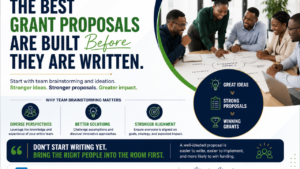
The ideation stage allows organisations to critically examine the problem they seek to address and determine the most effective solutions.
Key questions that should guide these discussions include:
- What specific problem are we trying to solve?
- What evidence supports the existence and scale of this problem?
- Who are the affected populations?
- What interventions have worked previously?
- What lessons have we learned from past projects?
- What partnerships, resources, and expertise can strengthen our response?
- How does this opportunity align with our organisational mission and strategic objectives?
Answering these questions collectively often reveals opportunities, risks, and innovations that might otherwise be overlooked.
One of the most common reasons proposals are difficult to develop is that teams start writing before achieving internal agreement on the project’s objectives, activities, outcomes, and implementation approach. Without alignment, proposal development becomes a process of constant revisions, conflicting inputs, and unrealistic expectations.
A well-structured brainstorming and ideation process ensures that everyone involved shares a common understanding of the project’s purpose, scope, and intended impact before drafting begins. This not only improves proposal quality but also enhances implementation readiness if funding is secured.
High-performing organisations recognise that grant development is an institutional responsibility rather than an individual task. They create systems that encourage collaboration, knowledge sharing, and collective ownership of funding opportunities.
Instead of asking, “Who will write this proposal?” they ask, “Who should contribute to shaping this idea?”
This shift in mindset transforms grant writing from a solitary exercise into a strategic organisational process.
The strongest grant proposals are not created on a computer screen. They are developed in brainstorming sessions, strategy meetings, and collaborative discussions where ideas are challenged, refined, and strengthened.
Before you begin drafting your next proposal, take the time to bring your team together. Encourage open dialogue. Leverage diverse expertise. Build consensus around the problem, solution, and expected impact. Because stronger ideas lead to stronger proposals.
The strongest grant proposals are not written in isolation. They are shaped by collaboration, tested through discussion, and strengthened by collective expertise. Bring your team into the process before you put pen to paper.
(Alfred Akerele is a Nigerian resource mobilisation consultant and grant writer with high-impact experience)