

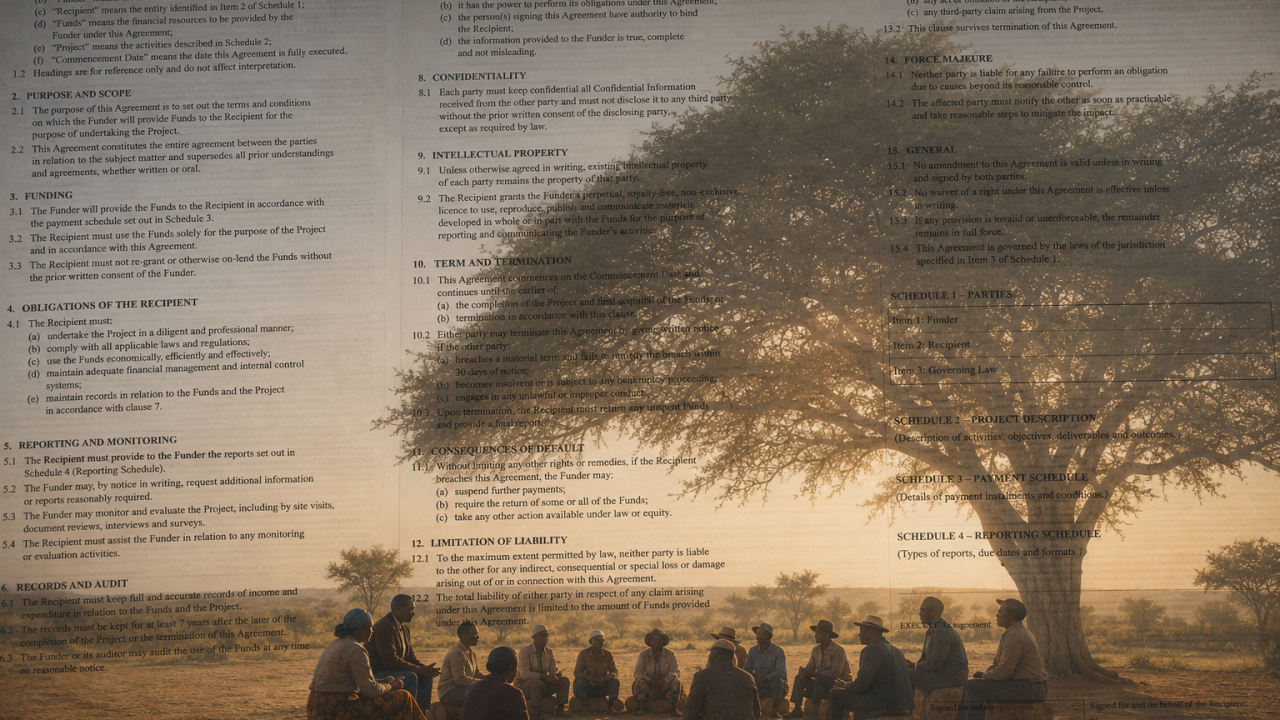
Moving Money Differently in the Crucible of Transition
By Mpho Raboeane
Some moments in the work appear ordinary from the outside: a contract signed, banking details verified, a compliance document received, a grant agreement returned with initials in all the right places. But beneath these administrative gestures, something tender is happening: resources are beginning to move towards people and places long asked to survive on too little.
Contracting the first round of grants with community-based organisations and advice offices feels like bringing ideals into concrete, transitional infrastructure. It is practical, urgent and sacred all at once: a reminder that money has memory, paperwork has power, and the way we move resources can either repeat old violences or rehearse new freedoms.
There is structural friction here that I cannot romanticise away. To anchor decolonial stewardship, community agency and radical trust inside legal architecture is to feel two worlds rubbing against each other. Still, we enter that friction consciously.
This reflection is about what it means to make contracts, compliance, and grant administration serve relationship, redistribution, and repair rather than suspicion, extraction, and control.
Beginning with the first round
This first round matters because beginnings teach us how we might continue. They reveal our habits, biases and the gap between what we say we believe and what our systems make possible. In the contracting process, I kept returning to one question: can an administrative process feel less like a gate and more like a bridge?
These organisations know bridges. They stand at the crossings between people and the state, between rights written on paper and rights made real in a queue, an affidavit, a call, a referral, a home visit, a difficult conversation. Yet it is often this very role as a bridge – neither here nor there – that has locked them out of issue-specific philanthropy.
On stewardship and humility
To steward shared resources is to begin with humility. These funds do not belong to us in any private sense. We are temporary custodians: called to listen for where the resource is needed, move it with integrity, and account for it without turning accountability into suspicion.
But stewardship cannot mean wishing the law and governance away. Capital does not move through a vacuum. It is policed by tax law, anti-money-laundering duties, audit requirements and institutional policies. If we invoke trust without designing structure, we may unintentionally leave the most vulnerable organisations exposed to the very systems we are trying to soften.
A liberatory decolonial practice asks us to notice the colonial afterlives that still live inside funding systems: forms that assume deficit, timelines that disregard local realities, language that makes community organisations feel small, and the quiet belief that knowledge only becomes legitimate when it enters an institutional template. At the same time, we must not be careless with shared resources. What is at stake is not only undoing an extractive status quo, but the material conditions that allow communities to move towards repair.
Against this, I want a practice of resourcing that is careful without being controlling, rigorous without being punitive, and accountable without forgetting relationship. I want contracts that do not flatten the people behind them, and reporting that can hold not only numbers, but texture: the stubbornness of a paralegal who keeps phoning, the relief of a family whose grant is restored, or the strategy of an office that feeds young people first through mutual aid and then supports their social entrepreneurship.
The contract as transition infrastructure
Alnoor Ladha and Lynn Murphy’s Post-Capitalist Philanthropy helps me name this paradox. Their work asks philanthropy to confront the history of wealth accumulation and the need for deeper shifts in how we see, relate and redistribute. The Transition Resource Circle speaks of liberating capital in service of Life, with attention to lineage, reconciliation and healing. That gives me a way to understand the contract as transition infrastructure: an imperfect container built inside the old world to protect the tender experiments of the next one.
In this frame, the legal shell becomes a shield rather than a shrine. The grant agreement, compliance checklist and audit trail are tools. They become dangerous when we mistake them for the work itself. But they can be useful when they protect resources from being captured, privatised, misused or pulled back from the commons. Compliance, at its best, becomes an act of care: the careful tending of a structure so that quiet, radical redistribution can happen inside it.
De-escalating the contract
Linda Alvarez’s work on Discovering Agreement and Conscious Contracts also offers language for what we were reaching towards: legally enforceable agreements that support alignment, creativity and a return to relationship when change or disagreement arises. This matters because traditional contracts often anticipate betrayal before they imagine care. They allocate blame before asking what the relationship is for.
To de-escalate the contract is not to weaken it. It is to make it more honest about what sustains the work. The preamble, the shared purpose, and the language of values and mutual recognition should not sit ornamentally at the front of the document. They should be the pulse. If conflict arises, the parties should be called back not only to the clauses and consequences, but also to the commitments that made the partnership worth entering in the first place.
What the process asked of us
This contracting process asked us to pay attention to the small things: the email that needed a clearer explanation, the document requested with care, the follow-up that could feel like pressure or support, the delay that needed honesty instead of silence. Process is never just process. Process is where power is felt.
- Trust has to be built into the architecture. If every step assumes risk lives only with the CBO, accountability becomes surveillance.
- Compliance must not become a new border. Requirements matter, but they should not humiliate, confuse or exclude the organisations we say we are trying to support.
- Time carries consequence. A delayed disbursement can become a delayed salary, a postponed community meeting, a closed office door, or a person turned away.
- Learning needs room to breathe. Our partners can’t be reduced to outputs alone; their work carries stories, patterns, warnings and wisdom about where justice is breaking down.
- The contract can map the relationship, not only the obligations. It can hold shared purpose, mutual check-ins, restorative dialogue and the funder’s own duties to the relationship.
A practice of moving differently
I keep thinking about what it means to move money differently. Not only faster, though speed matters when organisations are stretched. Not only more cleanly, though governance matters when resources are shared. I mean differently, in a deeper sense: with memory, consent, reverence for local knowledge, and an awareness that every system we build teaches people what we believe about them.
If our systems are slow, opaque and suspicious, they teach distrust. If they are clear, responsive and relational, they can teach something else: that community-rooted institutions are worthy of care; that the people closest to harm are also closest to knowledge; that justice work should not have to beg for the conditions of its own survival.
This is the ethics of the bilingual practitioner. I have to remain fluent in the radical, life-affirming language of decoloniality, relationality, and community agency, while also understanding the dry language of indemnities, governance protocols, reporting duties, and liability well enough to prevent it from doing harm. The work is not to let the sterile alphabet of law swallow the living grammar of liberation. The work is to bend the tool towards protection.
That is why this first round has felt like a crucible: not a perfect practice, but an honest attempt to build something strong enough to withstand scrutiny and soft enough to remember why it exists. A practice where reporting becomes learning, compliance protects rather than punishes, and community organisations are treated as co-stewards of a shared future.
Holding the milestone softly
I want to acknowledge this first round, but celebrate it softly, not as a finish line, and not as proof that the work is now simple. I want to celebrate it as a beginning that required many hands, many reminders, many acts of coordination, and a shared belief that advice offices and CBOs deserve to be resourced with seriousness and care.
Now the task is to keep listening after the signatures. To watch how the money lands. To ask whether the process feels supportive in practice. To notice where our own systems still need to be unlearned. To remain accountable not only to the donor and the file, but to the communities whose struggles give the work its moral centre.
Perhaps this is the lesson I am carrying most closely: resourcing justice is not only about transferring funds. It is about the spirit in which we transfer them, the structures we build around them, and the courage to keep those structures answerable to life. It is about refusing to let bureaucracy harden the heart of the work, and bending cold tools of enclosure into protective sanctuaries where dignity can travel with the money.
References
Alvarez, Linda. Discovering Agreement: Contracts That Turn Conflict Into Creativity. American Bar Association, 2016.
Ladha, Alnoor, and Lynn Murphy. Post-Capitalist Philanthropy: Healing Wealth in the Time of Collapse. Daraja Press / Transition Resource Circle, 2022.
(Mpho Raboeane is a South African human rights attorney and Grant Officer at ACT Ubumbano. She drives strategic initiatives, grantmaking and community partnerships to advance African sovereignty, centring locally rooted decision-making and a liberatory vision grounded in racial, economic and social justice.)